

What is Thermal Analysis? A Complete Guide
Making assumptions about material behavior is a significant business risk in a competitive market. Product performance and reliability are not just engineering goals; they are cornerstones of a company's reputation.
For the components inside our electronics, the polymers in our vehicles, and the compounds in modern medicine, knowing precisely how they will perform under thermal stress is a fundamental requirement for success. This is the point where you move past hypotheticals and into material verification, ensuring that what you've designed is what you deliver.
What is Thermal Analysis and Its Real-World Purpose?
At its core, it is a suite of methods for observing the physical and chemical nature of a material as it is subjected to heating, cooling, or a sustained temperature. We consider it a direct path to revealing a material's operational character, going beyond simple pass/fail tests.
It allows you to create a performance baseline—a fingerprint for your ideal material—so you can spot inconsistencies between batches or suppliers. A clear understanding of what is thermal analysis gives you a clear picture of a material's stability and compositional makeup. Frankly, this is how you identify product failures before they impact your production line.
Key Types of Thermal Analysis Techniques
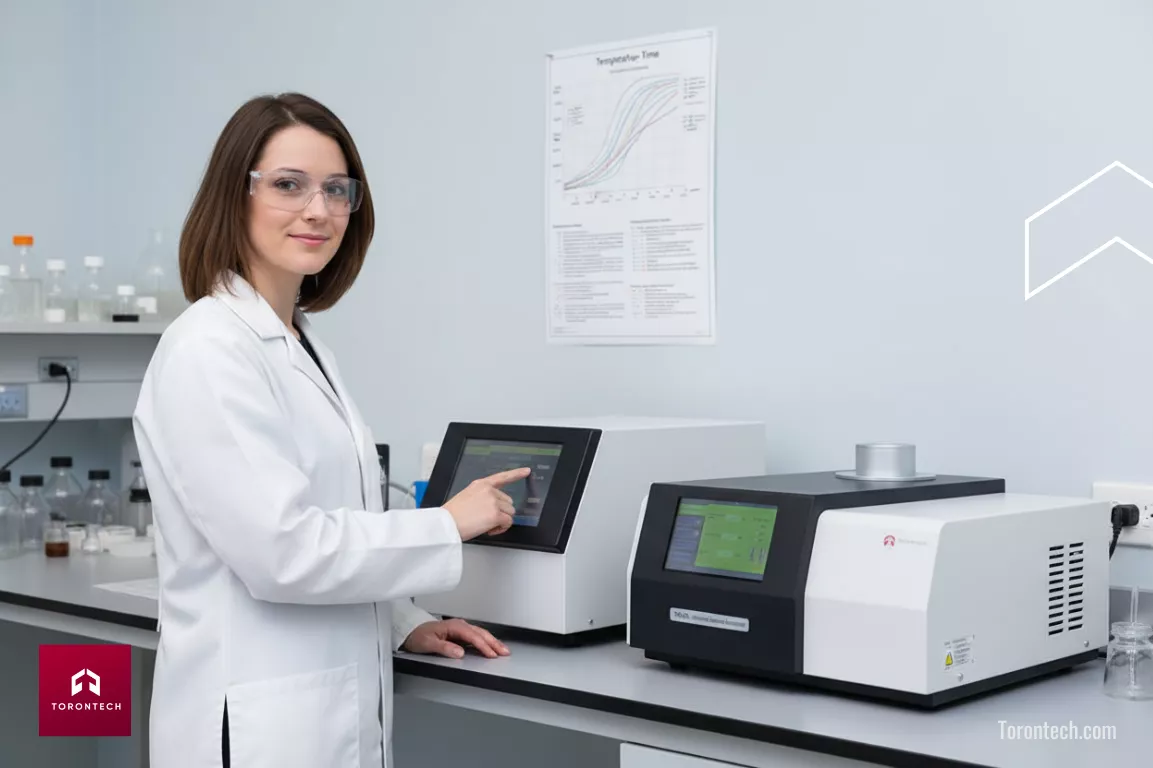 Among the many types of thermal analysis, a few key techniques have become the established standards that professionals across many industries depend on for clear results. Some, like TGA and DSC, are foundational tools for almost any lab, while other thermal analysis techniques are brought in to solve more specific, complex challenges.
1. Thermogravimetric Analysis (TGA)
From our professional standpoint, TGA is one of the most foundational thermal analysis techniques. It provides an exact measurement of a sample's mass as the temperature is altered, answering critical questions about when and how a material degrades.
For example, a tire manufacturer might use TGA to determine the carbon black content in a rubber sample. By heating the sample, the polymer burns off, leaving the carbon black and ash behind, which directly verifies the material's composition against its specifications.
It is also the go-to method for quantifying fillers, identifying residual solvents, and ensuring materials are stable. This is why we dedicated significant engineering resources to our ToronTGA Thermogravimetric Analyzer. Our objective was to create a robust instrument that delivers reliable results, making high-level quality control accessible.
Read more: Thermogravimetric Analysis – How TGA Helps You Analyze Material Stability
2. Differential Scanning Calorimetry (DSC)
Among the most useful types of thermal analysis, DSC is an ideal complement to TGA. It monitors heat flow to identify transitions like melting, crystallization, and glass transitions—events that don't involve a change in mass but are critical to performance.
In pharmaceutical development, for instance, DSC is critical for screening drug candidates. It can reveal the purity of a compound and identify different crystalline forms (polymorphs), which can have a major impact on a drug's stability and effectiveness.
Knowing these thermal signatures is also key to optimizing manufacturing processes. Just as with our TGA, we developed the ToronDSC Differential Scanning Calorimeter to deliver this kind of fast, accurate analysis. We focused on a design with a stable baseline and a user-friendly interface because we know dependable results are what matter most.
Read more: Differential Scanning Calorimetry DSC Analysis: A Practical Guide to Thermal Insights
3. Differential Thermal Analysis (DTA)
DTA is another well-established technique that operates on a similar principle to DSC. It registers the temperature difference between your sample and a reference material to detect thermal events. A classic use case is in metallurgy, where DTA can be used to quickly verify the melting point of a metal alloy for quality control.
While many facilities opt for the quantitative heat flow data from DSC, DTA remains a viable and straightforward choice for routine quality checks.
4. Thermomechanical Analysis (TMA)
For clients manufacturing components where dimensional tolerance is key, TMA is a vital tool. This thermal analysis technique measures how a material's dimensions change under a controlled force as a function of temperature. Consider a company producing printed circuit boards (PCBs).
They can use TMA to measure the coefficient of thermal expansion (CTE) of their board material to ensure it doesn't expand too much and crack delicate copper connections during operation. This data is critical for preventing failures caused by internal stresses.
5. Dynamic Mechanical Analysis (DMA)
While a more specialized method, DMA is an invaluable technique for high-performance applications. It assesses mechanical properties like stiffness and energy dissipation by applying an oscillating force to the sample.
An automotive engineer, for example, might use DMA to test a new polymer for an engine mount, finding a material stiff enough to support the engine but with high damping properties to absorb vibrations. It provides a deep look into the viscoelastic nature of a material, which is essential for parts that endure constant stress cycles.
A Comparative Overview of Thermal Analysis Techniques
| Technique | Primary Measurement | Common Industrial Uses |
| TGA | Change in mass | Verifying stability, composition, moisture levels |
| DSC | Flow of heat | Analyzing melting, crystallization, phase shifts |
| DTA | Difference in temperature | Identifying phase shifts, purity levels |
| TMA | Change in dimensions | Assessing expansion, shrinkage, softening points |
| DMA | Mechanical response | Evaluating stiffness, flexibility, structural integrity |
Selecting the Appropriate Thermal Analysis Technique
A frequent question we receive is how to choose from the different types of thermal analysis. The answer is always dictated by the information you need to obtain. Here is the thought process we guide our clients through:
- Stability and composition: If your main goal is to understand how a material degrades or to verify its composition, we consistently recommend TGA as the essential starting point.
- Phase transitions: To study events like melting or crystallization that define a material's processing and service temperatures, DSC is the standard instrument.
- Qualitative thermal events: When your primary goal is simply to identify the temperature at which a transition occurs (like a melting point) for routine quality checks, DTA offers a very straightforward and reliable solution.
- Dimensional changes: When you need to know precisely how a material will expand or shrink to ensure component compatibility, TMA will provide the necessary data.
- Mechanical performance: If you need to evaluate how a material behaves under load across a range of temperatures, DMA is designed to give you those critical performance answers.
Torontech: Your Partner for Cost-Effective Thermal Analysis
At Torontech, our focus is on providing practical, long-term solutions that align with your business objectives. A clear understanding of your material's properties through these thermal analysis techniques is a direct contributor to operational efficiency, product quality, and profitability.
We believe access to this critical data should not be a budgetary strain. Whether you need to verify material stability with our ToronTGA or characterize thermal transitions with our ToronDSC, we have an affordable, reliable instrument for the task. If you are ready to enhance your quality control and R&D capabilities, request a quote today. Our team is available to help you identify the right solution for your operational needs. Contact us to begin the conversation.
Want More Reliable TGA Results?
References:
- Hosseinian, H., Ortega, E., Meza, I., Vera, A., López, M., & Hosseini, S. (2022). Characterization Techniques for Thermal Analysis. Material Characterization Techniques and Applications. doi.org/10.1007/978-981-16-9569-8_5
- Brown, M. (1988). Introduction to Thermal Analysis: Techniques and applications.
- Wendlandt, W. (1964). Thermal methods of analysis.
- Charsley, E., & Warrington, S. (1992). Thermal analysis : techniques and applications.
- (1996). 2 – THERMAL ANALYSIS. doi.org/10.1016/B978-081551403-9.50004-2
- Tan, K., Hajek, B., & Barshad, I. (2018). Thermal Analysis Techniques. SSSA Book Series. doi.org/10.2136/SSSABOOKSER5.1.2ED.C7
- Morgan, D. (1989). Introduction to Thermal Analysis: Techniques and Applications. Mineralogical Magazine. doi.org/10.1180/minmag.1989.053.373.29

